after 1957 discontinued the use of other breeds and bred
American La Manchas to American La Manchas. The first
American La Manchas were registered in January, 1958.
In 1954, I purchased 36 head of American La Manchas from
the late Ira D. Peel. He had obtained them at a sale. I
culled this herd to just a few and kept only one of the
seven bucks. There were some real good animals in this
group.
I made it a point to always select the best purebreds
and grades to breed into my American La Mancha herd.
Many herd names are represented, some of which are
mentioned here. Oakwood, Del-Norte, Chikaming, Wasatch,
Delta, Rio Linda, Silver Pine, MacAlpine, Silvergate,
Hurricane Acres, Decor’OChevonshire, and I am sure quite
a few others not mentioned here.
To the breeders of these fine animals I owe a great
deal. To them I am very grateful.
The goal that I aimed at in breeding American La
Manchas was a breed that was able to produce 3-1/2 to
six quarts of fine-flavored milk with 3.5% or more
butterfat over a period of one to four years between
freshenings. They should have the w-way wedge body,
strong legs well-placed, udders well-attached, both
front and back, good barrel, short sleek hair, any color
or combination of colors, horned or hornless, and head
size of Toggenburgs.
the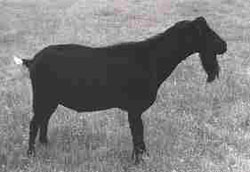 A dream that American La Manchas would some day become a
recognized and registered breed has come true.
A dream that American La Manchas would some day become a
recognized and registered breed has come true.
Mr. and Mrs. R. W. Soens are the first to own
registered La Manchas east of the Rocky Mountains, and
are also the first to have them on test.
Epilogue
At the annual banquet of the American Milk Goat
Record Association in Springfield, Illinois, October 15,
1960, the Mary L. Farley Award was given to Mrs. Eula
Fay Frey in recognition of her years of work in
developing the La Mancha breed.
Mrs. Frey died in 1968.
1 “Three
herd names dominated the list of approximately 235 goats
which were destined to become BASIC La Manchas. The Fay
candidates were inspected and registered in 1958 with Midolane and Blue
Diamond soon
added to their prefixes to the herdbooks. Other breeders
included R. W. Soens (Bomar), Then ANGRA
Secretary, the late Hazel Pike (Lucky Leaf), and
the late Ed Coulter (Coulter R).
The term BASIC refers to those short-eared goats which
were inspected for type, and presumably quality, by a
committee of experienced AMGRA members. Several of the
first 225, or so, are progeny of other BASICs. Were they
also inspected? For the purpose of this article, all
numbers up to and including number 225 are considered
BASIC.”
“The Short Ear Phenomenon,” Barbara Backus, Dairy
Goat Journal, Jan. 1981
2 “The
Murciana is a Spanish breed of dairy goat having been
developed in the province of Murcia. This area is in the
southeast of Spain along the Mediterranean. The ancient
kingdom of Murcia was first settled by the Romans and
reconquered by the Moors in the 13th Century. The
Murciana goat is not earless. It carries its short ears
almost horizontally, but the shape of its ear is like
that of the Swiss breeds. This breed may have actually
originated in Africa as some suspect.”
“As I see the American La Mancha,” S. Tachera, Dairy
Goat Journal, Jan. 1975
3 The
Murciana goat was clearly in the United States by 1920,
as display advertisements in The
Goat World of
the period attest. In these ads, this breed was referred
to as the “Royal Murciana,” although Dr. C. P. DeLangle,
in his article “The Murcien Goat” printed in the August
1921 issue of The
Goat World says,
“The only Royalty attached to it, is in the fancy of its
admirers, but, let it be said, that the true Murcien
goat is one, if not, the handsomest goat known.” He also
wrote of the Murcien: “It is a made-up breed like most
all important goats.”
By 1936 the Murcianas must have been a bit scarce.
Printed in the Murciana breed column of the January 1936
issue of the Dairy
Goat Journal, was an offer to help reestablish the
breed. The column indicated that “…at present, it is
doubtful if there is a pure-bred buck of this breed in
America. As far as is known Mrs. Katherine Kadel has the
only purebred does.” It goes on to say that while Mrs.
Kadel had tried to arrange for further importations from
Spain, regulations made this prohibitive. “However, the
Journal has scouted around and believes it has found a
reliable source of supply in Mexico, from a herd of
Murcianas (it also contains Granadas should anyone be
interested), imported several years ago from Apain.
Prices range from $30 to $100 each.”